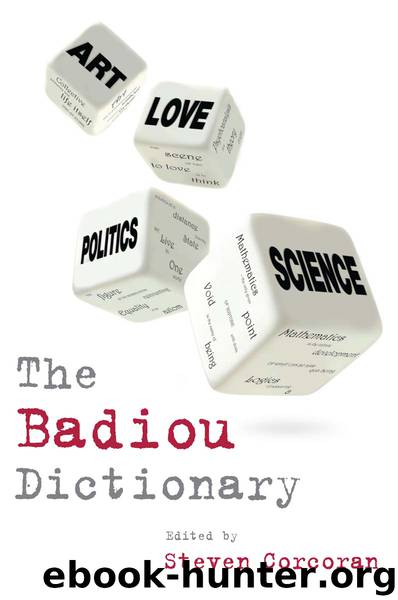
The Badiou Dictionary by Steven Corcoran
Author:Steven Corcoran
Language: eng
Format: epub
Publisher: Edinburgh University Press
Philosophy and Politics
In order to construct a positive relation to politics as thought, Badiou posits two basic statements, both of which are rejected by political philosophy: statement 1 is that philosophy must suppose the equality of intelligences. This axiom points to philosophy’s democratic condition, since philosophy necessarily presupposes that what counts is not the position from which a statement is enunciated but the statement’s objective content. Statement 2 stipulates the subordination of the variety of opinions to the universality of truths. Politics must be connected to the theme of truth, for it is only if a statement carries with it a rational obligation to accept ‘the existence of a universal logic, as formal condition of the equality of intelligences’ (PM 37), that it is valid for philosophy. The question here is about recognising the validity of arguments. In other words, the axiom of the equality of intelligences does not entail that all opinions are of equal worth. Although philosophy has a democratic condition it does not have a democratic destination (in the sense of the liberty of opinion): there is a freedom of address, but also the necessity for a strict rule for discussion. ‘Philosophy must maintain a strict rule of consequences’ (ibid.).
Badiou argues that only by taking these two statements together can philosophy identify politics as thought and as that which is capable of forming a condition for philosophy itself. Both statements must be posited, if we are to view politics as that which involves an always singular proposition about dis-placement that fractures the regime of organisation and representation, and is able to fold back onto this situation with a view to transforming it. These statements mark a positive relation between philosophy and politics, while necessarily insisting on their separation qua two dimensions of thought. Suppressing them is the core of political philosophy, which performs a suture that can lead to the worst.
Thus ‘people think’, ‘people are capable of truth’. Badiou’s summoning of Plato to help construct this axiom may seem odd. But what is of interest is precisely Plato’s insight into political thought, against all notions of politics as a sort of phronesis, i.e. a kind of practical wisdom for making strategic judgements in the pursuit of predetermined ends. Plato’s ‘ideal city’, as he makes clear, does not attain legitimacy on the basis of what is, of the ways of the world. Indeed Plato’s insistence is that political thought involves a prescriptive dimension that makes it intransitive to objectivity. That politics is a form of thought thus means that every politics involves an unconditioned prescription, i.e. a statement that does not have to establish the proof of its possibility with reference to objective reality. For Badiou, the fundamental being of politics is axiomatic. It involves deciding on the fundamental statements that inform political thought and action and is measurable not in terms of pre-established, i.e. objectively determinable, possibility, but purely in terms of the consistency of its effects. A political prescription is like a ‘writing-forward’ – it aims to create the conditions that retroactively justify it.
Download
This site does not store any files on its server. We only index and link to content provided by other sites. Please contact the content providers to delete copyright contents if any and email us, we'll remove relevant links or contents immediately.
| Anthropology | Archaeology |
| Philosophy | Politics & Government |
| Social Sciences | Sociology |
| Women's Studies |
The remains of the day by Kazuo Ishiguro(9004)
Tools of Titans by Timothy Ferriss(8403)
Giovanni's Room by James Baldwin(7352)
The Black Swan by Nassim Nicholas Taleb(7137)
Inner Engineering: A Yogi's Guide to Joy by Sadhguru(6799)
The Way of Zen by Alan W. Watts(6621)
The Power of Now: A Guide to Spiritual Enlightenment by Eckhart Tolle(5789)
Asking the Right Questions: A Guide to Critical Thinking by M. Neil Browne & Stuart M. Keeley(5779)
The Six Wives Of Henry VIII (WOMEN IN HISTORY) by Fraser Antonia(5519)
Astrophysics for People in a Hurry by Neil DeGrasse Tyson(5196)
Housekeeping by Marilynne Robinson(4455)
12 Rules for Life by Jordan B. Peterson(4312)
Double Down (Diary of a Wimpy Kid Book 11) by Jeff Kinney(4278)
Ikigai by Héctor García & Francesc Miralles(4278)
The Ethical Slut by Janet W. Hardy(4262)
Skin in the Game by Nassim Nicholas Taleb(4256)
The Art of Happiness by The Dalai Lama(4133)
Skin in the Game: Hidden Asymmetries in Daily Life by Nassim Nicholas Taleb(4012)
Walking by Henry David Thoreau(3968)
